Canadian Flag Canadian Centre for Occupational Health and Safety Centre canadien d'hygiène et de sécurité au travail Government of Canada Wordmark
CCOHS: Canadian Centre for Occupational Health and Safety
Français Contact Us Help
        
Canada Site
Web Info Service Products & Services OSH Answers Education & Training
Canada's national Occupational Health & Safety Resource
Home About Us E-News Bringing Health to Work Events Resources
OSH Answers Lists
What's New!
Subject Categories
Chemicals & Materials
Chemical Profiles (27)
Compressed Gases (2)
Control Banding
Converting Occupational Exposure Limits from mg/m3 to ppm
Corrosive Materials (2)
Cryogenic Liquids (2)
Dangerously Reactive Liquids & Solids (2)
Endocrine Disruptors
First Aid for Chemical Exposures
Flammable & Combustible Liquids (3)
Globally Harmonized System (GHS)
Glossary - Common Terms in MSDSs (3)
How Do Particulates Enter the Respiratory System?
How Workplace Chemicals Enter the Body
Indoor Air Quality - General
Material Safety Data Sheets (MSDSs) - Creating
Material Safety Data Sheets (MSDSs) - General
Metalworking Fluids
Organic Peroxides (2)
Oxidizing Liquids & Solids (2)
Pesticides (6)
Risk Phrases Used in the Countries of European Union
Safety Phrases Used in the Countries of European Union
Substitution of Chemicals: Considerations for Selection
Swimming Pool Chemicals
Synergism
Waste Anesthetic Gases, Hazards of
What are the Effects of Dust on the Lungs?
What is an LD50 and LC50
What Makes Chemicals Poisonous
WHMIS - Classification
WHMIS - Education and Training
WHMIS - General
WHMIS - Labelling Requirements
Related Products and Services

Databases:
CHEMINFO
MSDS

Management Systems:
MSDS Management Service
More Information
About OSH Answers
Feedback
Disclaimer
Inquiries Service

The Inquiries Service at CCOHS answers questions on the health or safety concerns people have about the work they do.

About the Inquiries Service
Ask a Question

Converting Occupational Exposure Limits from mg/m3 to ppm

When can I convert mg/m 3 to ppm?
What is the usual way of converting mg/m 3 to ppm?
What is gram molecular weight?
How do I convert mg/m 3 to ppm at different temperatures and pressures?


When can I convert mg/m3 to ppm?

Occupational exposure limits (OELs, TLVs, PELs, etc.) can be expressed in parts per million (ppm) only if the substance exists as a gas or vapour at normal room temperature and pressure. This is why exposure limits are usually expressed in mg/m3. However, some OELs may be expressed in units such as fibres/cc (e.g., for asbestos). OELs for metals, salts and other compounds that do not form vapours at room temperature and pressure are expressed in mg/m3 only.

What is the usual way of converting mg/m3 to ppm?

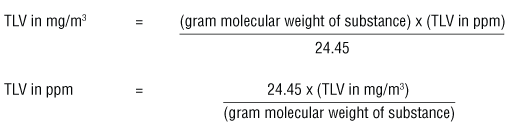
The ACGIH booklet "Threshold Limit Values (TLVs™) for Chemical Substances and Physical Agents and Biological Exposure Indices (BEIs™)" uses the formulas:

 TLV in mg/m3
=
(gram molecular weight of substance) x (TLV in ppm)
24.45
 TLV in ppm
=
          24.45 x (TLV in mg/m3)         
(gram molecular weight of substance)

These formulas can be used when measurements are taken at 25°C and the air pressure is 760 torr (= 1 atmosphere or 760 mm Hg).

What is gram molecular weight?

Gram molecular weight is the molecular weight (MW) expressed in grams. For example, the gram molecular weight for toluene is 92.13 g. since the molecular weight is 92.13. A gram molecular weight is also called a gram mole.

How do I convert mg/m3 to ppm at different temperatures and pressures?

The number 24.45 in the equations above is the volume (liters) of a mole (gram molecular weight) of a gas or vapour when the pressure is at 1 atmosphere (760 torr or 760 mm Hg) and at 25°C.

To convert mg/m3 to ppm at other temperatures and pressures, one must calculate the volume of 1 gram molecular weight of an airborne contaminant (e.g. 92.13 grams of toluene) by using the formula:

V = (RT/ P)

where R is the ideal gas constant; T, the temperature in  kelvins (273.16 + T°C); and P, the pressure in mm Hg. This information can be substituted in the formulas for converting between mg/m3 and ppm.
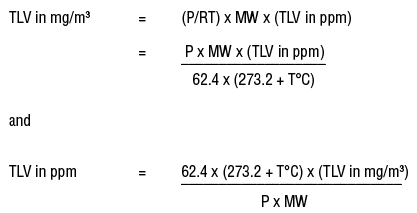
 TLV in mg/m3
= (P/RT) x MW x (TLV in ppm)
= P x MW x (TLV in ppm)
  62.4 x (273.2 + T
°C)

and

 TLV in ppm
=
 62.4 x (273.2 + TX) x (TLV in mg/m3)
 P x MW

where the value of R is 62.4 when the temperature (T) is in kelvins, K (=273.16 + T°C), the pressure is expressed in units of mm Hg and the volume is in liters. There are different values for the gas constant R if the temperature is expressed degrees Fahrenheit (°F) or if other units of pressure (e.g., atmospheres, kilopascals) are used.

Document last updated on February 21, 2000

Copyright ©1997-2008 Canadian Centre for Occupational Health & Safety


Important Notices and Disclaimers
©CCOHS, 2008
Technical Support
 
Client Services
Products & services info
Inquiries Service
Answers to workplace questions
Webmaster
Website feedback