
Safety Footwear
On this page
What should I know about safety footwear?
Back to topIf you are at risk for foot injury at your workplace, you should wear the appropriate protective footwear.
- If foot protection is required, set up a complete foot safety protection program, including selection, fit testing, training, maintenance and inspection.
- Safety footwear is designed to protect feet against a wide variety of injuries. Impact, compression, and puncture are the most common types of foot injury.
- Choose footwear according to the hazard. Refer to CSA Standard Z195-14 (R2019) "Protective footwear" or other standards that are required in your jurisdiction.
- Select CSA-certified footwear (or other certified footwear if permitted in your jurisdiction). Make sure that it has the proper rating for the hazard and the proper sole for the working conditions.
- Use metatarsal protection (top of the foot between the toes and ankle) where there is a potential for injury.
The OSH Answers section on Foot Comfort and Safety at Work has more information on foot care and selection of protective footwear.
How is footwear selected?
Back to topFootwear must be chosen based on the hazards that are present. Assess the workplace and work activities for:
- Materials handled or used by the worker.
- Risk of objects falling onto or striking the feet.
- Any material or equipment that might roll over the feet.
- Any sharp or pointed objects that might cut the top of the feet.
- Objects that may penetrate the bottom or side of the foot.
- Possible exposure to corrosive or irritating substances.
- Possible explosive atmospheres, including the risk of static electrical discharges.
- Risk of damage to sensitive electronic components or equipment due to the discharge of static electricity.
- Risk of coming into contact with energized conductors of low to moderate voltage (e.g., 220 volts or less).
- Type of walking surface and environmental conditions workers may be exposed to (e.g., loose ground cover, smooth surfaces, temperature, wet/oily, chemicals, etc.).
Also, evaluate the following risks:
- Ankle injury from uneven walking surfaces or rough terrain.
- Foot injury due to exposure to extreme hot or cold.
- Slips and falls on slippery walking surfaces.
- Exposure to water or other liquids that may penetrate the footwear, causing damage to the foot and the footwear.
- Exposure to rotating or abrasive machinery (e.g., chainsaws or grinders).
What should I know about the fit and care of safety footwear?
Back to topFit:
- Try on new boots around midday. Feet normally swell during the day.
- Walk in new footwear to ensure it is comfortable.
- Boots should have ample toe room (toes should be about 12.5 mm from the front). Do not expect footwear to stretch with wear.
- Make allowances for extra socks or special arch supports when buying boots. Try on your new boots with the supports or socks you usually wear at work. Check with the manufacturer if adding inserts affects your level of protection.
- Boots should fit snugly around the heel and ankle when laced.
- Lace-up boots fully. High-cut boots provide support against ankle injury.
Care:
- Use a protective coating to make footwear water-resistant.
- Inspect footwear regularly for damage (e.g., cracks in soles, breaks in leather, or exposed toe caps).
- Repair or replace worn or defective footwear.
- Electric shock resistance of footwear is greatly reduced by wet conditions and with wear.
- Footwear exposed to sole penetration or impact may not have visible signs of damage. Replacing footwear after an event is advisable.
What symbols will be on the footwear?
Back to topThe following symbols, or markings, will help you determine which footwear is appropriate for the job.
| Selection of Safety Footwear | ||
| Marking | Criteria | Intended Application |
 | Green triangle indicates sole puncture protection with a Grade 1 protective toecap. | For heavy industrial work environments, especially that of construction where sharp objects (such as nails) are present. |
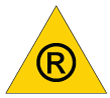 | Yellow triangle indicates sole puncture protection with a Grade 2 protective toecap. | For light industrial work environments requiring puncture protection as well as toe protection. |
 | Blue rectangle indicates a Grade 1 protective toecap with no puncture-resistant sole. | For industrial work environments not requiring puncture protection. |
 | Grey rectangle indicates a Grade 2 protective toecap with no puncture-resistant sole. | For industrial and non-industrial work environments not requiring puncture protection. |
 | White rectangle with orange Greek letter omega indicates electric-shock protective footwear. | For industrial work environments where accidental contact with live electrical conductors can occur. Warning: Electrical shock resistance deteriorates with wear and in a wet environment. |
 | Yellow rectangle with black SD letters indicates static-dissipative footwear. | For industrial work environments where a static discharge can create a hazard for workers or equipment. Warning: This footwear should not be used where contact with live electrical conductors can occur. |
 | Yellow rectangle indicates sole puncture protection with a Grade 2 protective toecap. (super-static dissipative footwear) | For industrial work environments where a static discharge can create a hazard for workers or equipment. Warning: This footwear should not be used where contact with live electrical conductors can occur. |
 | Red rectangle with white C letter indicates electrically conductive footwear. | For industrial work environments where low-power electrical changes can create a hazard for workers or equipment. Warning: This footwear should not be used where contact with live electrical conductors can occur. |
 | Dark grey rectangle with M letter indicates metatarsal protection. Note: Toe protection is required for all metatarsal protective footwear. | For industrial work environments where heavy objects can hurt the metatarsal region of the foot. |
 | White label with green fir tree symbol footwear provides protection when using chainsaws. | For forestry workers and others who work with or around hand-held chainsaws and other cutting tools. |
NOTE: Footwear will also be marked to indicate the level of slip resistance. These markings may be on the packaging, the footwear, or on a product sheet.
Note: Certain CSA Group standards are available for online viewing. To access these, you must first create an account with “CSA Communities”.
Go to: https://community.csagroup.org/login.jspa?referer=%252Findex.jspa
Once you are logged in, click on the text below the “OHS Standards / View Access” graphic.
Click on the jurisdiction of your choice to see the CSA Standards as referenced in that legislation.
Standards may also be purchased from CSA Group: https://store.csagroup.org/
- Fact sheet last revised: 2020-10-22