
Hand Tools - Pliers and Wire Cutters
On this page
What are common types of pliers and wire cutters?
Back to topPliers are made in various shapes and sizes and for many uses. Some are used for gripping something round like a pipe or rod, some are used for twisting wires, and others are designed to be used for a combination of tasks, including cutting wire. There are also tools that are used just for cutting wires (as opposed to wire cable and rope). Use the correct pliers or wire cutters for the job.
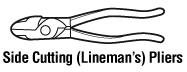
Proper use of side cutting (lineman's) pliers:
- Many applications, including electrical, communications and construction work
- Use to grip, splice or cut wires and strip insulation.
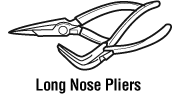
Proper use of long nose pliers:
- Use to grip small objects, reach awkward places, hold wires, bend loops, and attach wires
- Work involving smaller gauge wire.
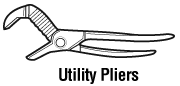
Proper use of utility pliers:
- Use to grip round square, flat and hexagonal objects.
- Can apply limited torque (twisting force) without damaging the work.
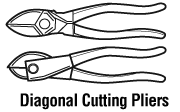
Proper use of diagonal cutting pliers:
- For work involving cutting and skinning wires, cutting and removing pins, nails and other fasteners.
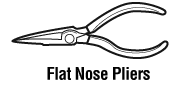
Proper use of flat nose pliers:
- Common pliers are used in many applications and assembly work.
- Use to grip, turn and bend wires.
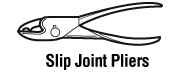
Proper use of slip joint pliers:
- Used to adjust nuts or bolts.
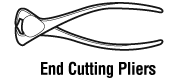
Proper use of end cutting pliers
- Use for cutting wires, nails, and rivets close to work.
What are some safety tips to know when using pliers and wire cutters?
Back to top- Wear safety glasses, goggles or a face shield (with safety glasses or goggles) whenever there is a potential hazard from flying particles, pieces of wire, etc.
- Cut at right angles. Never rock the cutting tool from side to side or bend the wire back and forth against the cutting edges.
.gif)
.gif)
- Choose pliers or wire cutters that have a grip span of 6 cm - 9 cm (2 1/2 - 3 1/2 in.) to prevent your palm or fingers from being pinched when the tools are closed.
- Use adjustable pliers that allow you to grip the workpiece firmly while maintaining a comfortable handgrip (i.e., hand grasp is not too wide).
- Use tools only if they are in good condition.
- Make sure that the cutting edges are sharp. Dull and worn-down cutting edges require much more force than needed for cutting.
- Make sure that the toothed jaws are clean and sharp. Greasy or worn-down jaws can result in compromised safety. Such tools also require increased force to hold the workpiece, which, in turn, increases the risk of muscular fatigue and repetitive strain injuries. Replace tools when the teeth or cutters are worn.
- Use the correct size pliers. Keep the plier's jaws as parallel as possible for a better grip.
- Oil pliers and wire cutters regularly. A drop of oil on the hinge will make the tools easier to use.
- Pull on the pliers; do not push away from you when applying pressure. If the tools slip unexpectedly, you may lose your balance or hit your hand against equipment or something else hard that could result in an injury.
What should I avoid doing?
Back to top- Do not cut hardened wire unless the pliers or wire cutters are specifically manufactured for this purpose.
- Do not expose pliers or wire cutters to excessive heat.
- Do not bend stiff wires with light pliers. Needle nose pliers can be damaged by using the tips to bend large wires. Use a sturdier tool.
- Do not use pliers as a hammer.
- Do not hammer on pliers or wire cutters to cut wires or bolts.
- Do not extend the length of handles to gain greater leverage. Use a larger pair of pliers for gripping or a bolt cutter for cutting.
- Do not use cushion grip handles for jobs requiring tools with electrically insulated handles. Cushion grips are primarily for comfort and do not protect against electric shock.
- Do not use pliers on nuts and bolts because they can round the corners of the nut or bolt; use a wrench.
Refer to the OSH Answers on General Hand Tool Operation for more tips.
- Fact sheet last revised: 2024-01-16