
Metalworking Machines - Lathes
On this page
What should you know before using a lathe?
Back to topLathes can be dangerous if not used properly.
- Read the owner's manual carefully.
- Make sure you understand instructions and are properly trained before operating a lathe.
Refer to Metalworking Machines - General for basic safety tips.
What are some good safety principles to follow when using a lathe?
Back to top- Wear appropriate CSA-certified safety glasses. It may be necessary for others in the area to wear safety glasses too as objects will fly off the work.
- Make sure entanglement hazards are removed (e.g. loose clothing, jewellery, etc.). Tie back and confine long hair.
- Keep the floor free from obstructions, or slip hazards.
- Make sure the lathe has a start/stop button within easy reach of the operator.
- Make sure the lathe has an emergency stop button (e-stop).
- Follow job specifications for the speed, feed and depth of cut for materials being turned. Make sure all work runs true and centered.
- Centre-drill work deeply enough to provide support for the piece while it is turning.
- Secure and clamp the piece being worked.
- Adjust tool and tool rest so that they are slightly above the centre of the work.
- Use a lifting device to handle heavy chucks or work. Refer to Materials Handling for additional information.
- Inspect chucks for wear or damage. Flying pieces can be very dangerous.
- Remove chuck wrench immediately after adjusting chuck.
- Use a barrier guard when operating the lathe in semi-automatic or automatic mode.
- Guard all power transmission parts.
- Remove all tools, measuring instruments and other objects from saddle or lathe bed before starting machine.
- Keep all lathe cutting tools sharp.
- Ensure that the chip and coolant shields are in place.
- Shut off the power supply to the motor before mounting or removing accessories.
- Stop lathe before taking measurements of any kind.
- Use a vacuum, brush or rake to remove cuttings only after the lathe has stopped moving.
- Keep working surface clean of scraps, tools and materials.
- Keep floor around lathe clean and free of oil and grease.
What steps should you follow when filing?
Back to topThis procedure is done by hand. Take extra care because it involves reaching over rotating work.
- Cover lathe bed with paper.
- Set lathe at twice the speed used for turning.
- Adjust work freely between centres. If available, use a rotating dead centre.
- Disengage lead screw by placing the reverse lever in a neutral position.
- Select a suitable long-handled lathe or mill file with a properly fitted handle.
- Grip file handle in left hand and use the fingers of the right hand to balance and guide file at the point. This method ensures that arms and hands will be clear of the head stock.
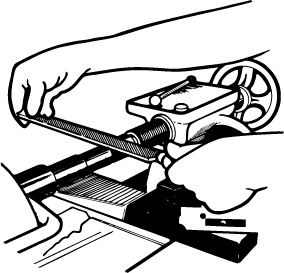
- Move file along work after each stroke so that each cut overlaps approximately one half the width of the file.
- Use long strokes, applying pressure only on forward stroke.
- Use approximately 40 strokes per minute.
- Clean loaded file with file brush and rub file teeth with a little chalk.
What are some things you should avoid doing?
Back to top- Do not wear gloves, rings, watches or loose clothing. Tie back and confine long hair.
- Do not lean on machine. Stand erect. Keep your face and eyes away from flying chips.
- Do not make adjustments while the machine is operating. Wait until the machine has come to a complete stop.
- Do not place hands on work turning in the lathe.
- Do not use calipers or gauges on a workpiece while machine is moving.
- Do not make heavy cuts on long slender pieces because the work could bend and fly out of the lathe.
- Do not leave lathe unattended while it is running.
- Fact sheet last revised: 2018-11-28