
Platforms - Decks
On this page
What are some safety tips for decks on a scaffold?
Back to top- Use wooden and metal decks according to job requirements, standards, occupational health and safety regulations and manufacturer's instructions.
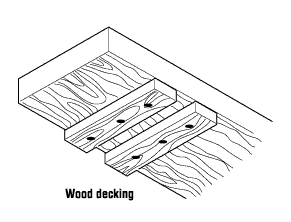
- Only cleat planks at the ends to prevent lengthwise movement. Wiring down planks can also prevent movement, provided wire does not create a tripping hazard. Where planks overlap, rest the cleated end on the support. Do not use cleats elsewhere on the plank to prevent splitting.
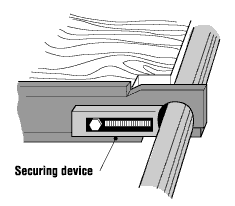
- Make sure that adjoining planks are of uniform thickness for an even platform.
- Lay planks side by side across the full width of the scaffold.
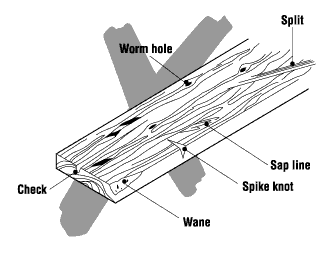
- Check scaffold planks for large knots, worm holes, steeply sloping grain at the edges, spike knots, and splits. Splits wider than 10 mm (3/8 in), lengthwise closer than 75 mm (3 in.) to the edge of the plank, or lengthwise longer than ½ the length of the plank are not acceptable. Discard immediately any planks showing these or other defects.
- Check hooks and hardware of prefabricated platform units regularly for looseness, distortion and cracks. Damage can occur if the platforms are dropped or thrown.
- Clean ice, snow, oil and grease off planks. Platform decks should be slip-resistant and should not accumulate water.
- Inspect planks on a regular basis while on the scaffold. Weather, rot, and general use can deteriorate the planks.
- Do not jump on the planks to test their strength. Jumping can cause undetectable damage.
What are minimum recommendations for the deck?
Back to top- Make sure that all working platforms are about 500 mm (20 in.) minimum in width.
- Try to plank the entire working level of a scaffold for maximum support and stability. Use a minimum of 48 mm thick Number 1 Grade spruce-pine-fir (SPF) planking or better.
- Overlap or extend planking 150 mm (6 in.) to 300 mm (12 in.) and cleat at each end to prevent planking from slipping and blowing off.
- Support planks at intervals not exceeding 3m (10 ft) for light work and 2.1 m (7 ft.) for heavy work (bricklaying, masonry).
- Check with officials in your local jurisdiction as recommendations may vary.
How should decking be stored?
Back to top- Stack planks on a firm level surface to prevent warping.
- Band the ends of the boards. Do not paint as the paint can conceal defects.
- Do not use scaffold planks as a base to stack materials, or as ramps or temporary roadways.
- Fact sheet last revised: 2018-02-05