
Powered Hand Tools - Ergonomics
On this page
What are the ergonomic concerns for selecting powered hand tools?
Back to top- Select tools that can be used without bending the wrist. Hand tools should allow the operator to grasp, hold, and use the tool with the wrist held straight.
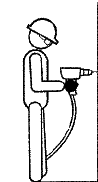
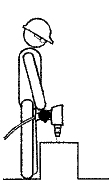
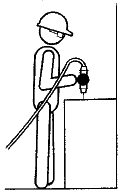
- Select the tool with the workplace layout and job design in mind. Sometimes a tool is correct for one operation and incorrect for another.
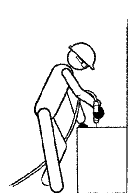
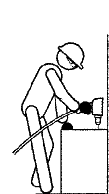
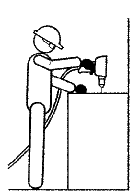
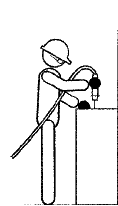
- Use the right tool for the job. Ensure it is the right size and has sufficient power to do the job safely.
- Weight of the tool and distribution of the load affect the way the user holds the tool. Limit the weight of the tool to 1.4 kg (3 lbs) or less for tools operated with one hand. For precision operations, tools should weigh less than 0.5 kg (1 lb). When there is a choice, select a tool of a low-weight.
- When the weight of a tool cannot be reduced, use a tool balancer.
- Select low-vibrating tools.
- Choose tools with vibration-absorbing handles, like those covered with cork, rubber, plastic or plastic bonded to steel, to reduce hand-arm vibration.
- Choose hand tools that have the centre of gravity within or close to the handle, or that help line up the tool’s centre of gravity with the gripping hand.
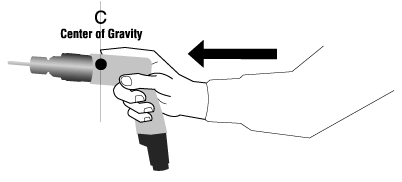
- Choose the tools with handles that can be held using a power grip. A power grip allows the operator to align the fingers such that they work with, rather than against, each other to maximize the grip.
- Select tools with rounded, cylindrical, or oval shape, and smooth handles that you can grip easily.
- Choose handles that extend at least the same length as the palm of the hand to prevent pressure points in the middle of the palm. Where possible, the handle length should be 14 cm (5.5 inches) with a minimum of 10 cm (4 inches). A longer handle length may be required if work is performed wearing gloves.
- If they are available, choose hand tools with double handles to permit easier holding and better manipulation of the tool.
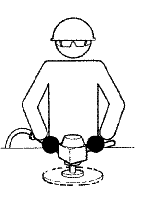
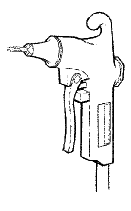
- Select tools with a trigger strip, rather than a trigger button. This strip will allow you to exert more force over a greater area of the hand that, in turn, will reduce muscle fatigue. Triggers should be larger than 2.5 cm (1 in) so that more than one finger can be used.
- Ensure that the trigger works easily to reduce the effort needed to operate it.
- Select hand tools that encourage a good grip, such as non-slip, non-conductive and compressible materials like plastics or compound rubbers. The goal is to reduce the effort needed to use the tool effectively and at the same time, prevent the tool from slipping out of the hand.
How can you reduce the ergonomic hazards of working with powered hand tools?
Back to top- Use the right tool for the job and the right tool for the user.
- Ensure that your tool is well maintained and in good repair.
- Do not use glossy coated and highly polished handles.
- Frequently used tools that weigh more than 0.5 kg (1 pound) should be counter-balanced.
- Hold the tool close to the body. Do not overreach.
- Hold the tool or press the trigger with the correct amount of force to control its action. Let the tool do the work. Do not use unnecessary force.
- Keep good balance and proper footing at all times. This posture will help operators to control the tool better, especially in response to unexpected situations.
- Make sure to secure work with clamps or a vise, freeing both hands to operate the tool.
- Rest your hands by putting the tool down when you are not using it.
- Reduce power to the lowest setting that can complete the job safely. This action reduces tool vibration at the source.
- Follow the manufacturer’s instructions for changing accessories and maintenance.
- Try to avoid or limit the use of hand tools with vibration or excessive torque.
- Consider wearing anti-vibration gloves. However, you should not wear thick or heavy gloves if operating the tool requires precise movements. The OSH Answers document Vibration - Measurement, Control and Standards has additional information on anti-vibration gloves.
- Keep work areas that are well lit when operating powered hand tools.
- Fact sheet last revised: 2023-11-22