
Welding - Storage and Handling of Compressed Gas Cylinders
On this page
- What are the employers’ responsibilities for the storage of compressed gas cylinders?
- What are the workers’ responsibilities when storing compressed gas cylinders?
- What welding gases can be stored together?
- What should be avoided when handling gas cylinders?
- When should a leak test be done, and what type of solution must be used?
- What should be done if a leak cannot be fixed?
- What should be done with empty or out-of-service cylinders?
- How should cylinders be moved around a facility or within the company’s property?
- When should a cylinder be “cracked”?
- What should be done if fuel cylinders are on fire?
- How do I transport cylinders on public roadways?
Back to top
Storage requirements must be followed when compressed gas cylinders are considered to be "in storage."
Examples of "in use" include when a single cylinder of oxygen or fuel gas is attached to an approved delivery system (e.g., regulator, manifold, etc.), or when they are secured and are directly supplied to appliances or equipment (these situations are not considered to be "in storage"). These cylinders are considered to be “in-use” or “connected for use” (as opposed to “in storage”) and are not regulated by the storage requirements in the applicable Fire Codes.
Check your jurisdiction for specific requirements, such as the fire code, for guidelines about the storage of flammable gas cylinders.
What are the employers’ responsibilities for the storage of compressed gas cylinders?
Back to top
Employers must make sure the following are put in place when compressed gases are used or stored at the workplace:
- Develop and implement a safe operating procedure for the safe handling and storage of compressed gas cylinders. The safe operating procedure must be prepared by a safety technical specialist and be based on the hazards of the gases present when used, stored, or handled. Include a description that outlines a gas cylinder is considered to be “in storage” versus “in use.”
- Make sure the workers receive the necessary training, including WHMIS.
- Keep an accurate and up-to-date inventory of all cylinders.
Control the maximum quantities of gases allowed on site as per legislative requirements. - Make sure fuel gas cylinders are not stored in cabinets, whether totally enclosed or vented. When security is a concern for mobile gas welding systems, a screened cage can be used to contain the cylinders; however, at least two sides of the cage must have an 80% or greater area, which allows for airflow.
- Monitor for flammable and oxygen gas levels in the storage area.
Know the local requirements for firewall specifications and separation distances for incompatible gases. - Make sure compressed gas containers and systems are secured and protected against physical damage and tampering.
- Select outdoor storage areas that are well-drained with a concrete or other non-combustible platform. Asphalt of hydrocarbon-based paving material should not be used for the storage of oxidizing gases. In addition, the area needs to be located where the cylinders will not be exposed to humid conditions.
- Make sure the storage area location meets the jurisdiction’s distance requirements from forested areas. Make sure the surrounding area is maintained so that there is no grass, weeds, brush, or other vegetation within the specified distance by the jurisdiction. Generally, this distance is six metres.
- Make sure that indoor storage gas rooms are constructed according to the specifications in the building, electrical, and fire codes.
- Post "no smoking" signs in the indoor and outdoor storage areas.
- Establish and post a maximum use temperature of less than 48.9°C (120°F) and a maximum temperature for indoor and outdoor storage of less than 51.7°(125°F).
- Consider setting up the cylinder storage so that each cylinder can be secured separately to prevent other cylinders from falling when one of them is removed from storage.
What are the workers’ responsibilities when storing compressed gas cylinders?
Back to top
- Store compressed gas cylinders according to your organization’s safe operating procedure.
- Make sure you have received the necessary training, including WHMIS. Only trained workers are allowed to handle compressed gases.
- Do not smoke in compressed gas storage areas (indoors or outdoors). Note that oxygen alone will not combust, but it will vigorously support and accelerate combustion, causing flammable materials to burn with great intensity. Oil or grease in the presence of oxygen can ignite readily and burn violently.
- Wear the required (if any) personal protective equipment (PPE) and use only the appropriate equipment (e.g., carts, tools, fittings, and equipment).
- Before using or storing the cylinders, make sure they are properly identified or labelled and that they are in good condition. For cylinders that are not in good condition (e.g., the valve is hard to operate or there is visible damage), place a warning label on it, and report it to the supervisor to have it removed from service.
- Store cylinders in a clearly identified, dry, well-ventilated storage area that is not exposed to heat or the direct rays of the sun, and away from doorways, aisles, elevators, gangways, stairs, electrical outlets, etc.
- Identify empty cylinders with a tag and store them separately from full cylinders.
- Store cylinders, both empty and full, in the upright position (unless otherwise instructed).
- During storage, close the cylinder valves with the protective caps or a specific protective device in place.
- Secure cylinders with an insulated chain or non-conductive belt to protect cylinders from falling or becoming damaged.
- When storing outside, make sure the cylinders are stored in the designated storage area. Place the cylinders on a raised concrete pad (or other non-combustible platform) or noncombustible rack inside a secure designated area that is fenced in. The platform should be designed to prevent the cylinders from corroding from contact with ground, ice, snow, water, salt, and high temperatures.
- Unless otherwise instructed, when storing indoors, store the cylinders only in rooms that are specifically designated. These rooms must meet specific design, electrical, and ventilation requirements as outlined in the fire, electrical and building codes.
- Protect cylinders from falling. Secure the cylinders according to the instructions in the safe operating procedure. Tip! Securing each cylinder separately prevents other cylinders from falling when one of them is removed from storage.
- Store acetylene and liquefied gas cylinders valve end up. Close the valve and keep the protective device in place.
- Cylinders must also be separated away from flammable products and from materials that easily ignite (such as wood, paper, oil, grease, etc.). Unless otherwise specified in the safe operating procedure, the general recommendation is to store oxygen cylinders and fuel gas cylinders separately when "not in use." This method applies to indoor and outdoor storage.
- Separate oxygen from fuel gas cylinders by at least 6.1 m (20 ft), or by a wall at least 1.5 m (5 ft) high with a minimum half-hour fire resistance.
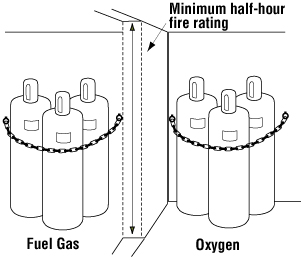
- The temperature of the storage area should not be above 51.7°(125°F)
- Make sure there are "no smoking" signs in the area.
- If oxygen cylinders are stored in an outdoor acetylene generator house, the cylinders must be separated from the generator and carbide storage room by a non-combustible barrier with a fire-resistance rating of at least 1 hour, that has no openings and is gas tight.
Note that when a single cylinder of oxygen and fuel gas are attached to a cylinder or secured to a wall or column at a workstation, this situation is not considered storage, and the cylinders do not necessarily need to be separated by distance or a barrier.
What welding gases can be stored together?
Back to topThe following table lists storage recommendations. Always follow the instructions on the safety data sheet or those provided by the manufacturer.
| Welding gas | Oxygen | Fuel gases | Inert gases | Carbon dioxide |
|---|---|---|---|---|
| Oxygen | Group oxygen gas cylinders together. | Separate at least 6.1 m (20 ft), or by a wall at least 1.5 m (5 ft) high with a minimum half-hour fire resistance. | No separation is required. Can be stored together | No separation is required. Can be stored together |
Fuel gases (e.g., propane, propylene, acetylene, or hydrogen) | Separate at least 6.1 m (20 ft) or by a wall at least 1.5 m (5 ft) high with a minimum half-hour fire resistance. | Group fuel gas cylinders together. | The National Fire Code does not require separation. Good industry practices (e.g., the Canadian Gas Association) recommend separation. Generally, a minimum of 3 metres separation is recommended. | The National Fire Code does not require separation. Good industry practices (e.g., the Canadian Gas Association) recommend separation. Generally, a minimum of 3 metres separation is recommended.
|
Inert gases (e.g., argon, helium, or nitrogen | No separation is required. Can be stored together | The National Fire Code does not require separation. Good industry practices (e.g., the Canadian Gas Association and other authorities) recommend separation. Generally, a minimum of 3 metres separation is recommended. | Group inert gases together. | Not applicable
|
| Carbon dioxide | No separation is required. Can be stored together | The National Fire Code does not require separation. Good industry practices (e.g., the Canadian Gas Association) recommend separation. Generally, a minimum of 3 metres separation is recommended | No separation is required. Can be stored together | Group carbon dioxide gases together. |
What should be avoided when handling gas cylinders?
Back to top
- Do not accept compressed gas cylinders from the supplier unless they are properly labelled, are in good condition, and have protective valve caps in place.
- Do not use a cylinder that is not identified or if the label is not legible (readable). The colours of industrial gas cylinders are not standardized.
- Do not use cylinders that have been dropped.
- Do not smoke or carry an open flame.
- Do not use the compressed gas cylinders when the temperature exceeds 48.9°C (120°F).
- Never tamper with or alter cylinders, valves, or safety relief devices.
- Do not use a hammer or wrench to open cylinder valves that are fitted with hand wheels. If valves cannot be opened by hand, let your employer (e.g., supervisor) know, as the employer will need to contact the supplier of the gas cylinder for guidance.
- Do not use pry bars under valves or valve protection devices.
- Do not use a cylinder as an electrical ground connection.
- Do not heat cylinders. Keep flames away from cylinders.
- Do not use a flame or boiling water to thaw a frozen valve. Valves or cylinders may contain fusible plugs which can melt at temperatures below the boiling point of water. Warm water is acceptable.
- Do not use a flame to test for a gas leak. Check for leaks at the regulator inlet and outlet connections by applying a commercial leak detection product suitable for the gas in the cylinder. If testing for leaks with soapy water, it is very important that the soap not have oil, grease or fat base. If a leak is detected, close the cylinder valve and correct the leak before use.
- Do not fasten cylinders to a worktable or to structures where they could become part of an electrical circuit.
- Do not strike an electrode against a cylinder.
- Do not pry cylinders loose when frozen to the ground. Use warm water.
- Do not place or store cylinders in unventilated enclosures such as lockers, cupboards, or confined spaces.
- Do not store acetylene cylinders, particularly small cylinders used for soldering, in confined spaces such as drawers, closets, unventilated cabinets, automobile trunks, or toolboxes. Acetylene cylinders should not be stored or transported in an enclosed vehicle.
- Do not place acetylene cylinders in a horizontal position.
- Do not use full or empty cylinders as rollers or supports.
- Do not store oxygen in an indoor acetylene generator room.
- Never transfer gases from one cylinder to another. Never fill cylinders. Only the suppliers or persons authorized by the supplier are allowed to transfer gas or fill a cylinder.
- Do not use a cylinder for any purpose other than to contain the gas for which the cylinder was designed.
Please refer to the following OSH Answers for additional information on the storage and handling of compressed gas cylinders How to Work Safely with - Hazardous Products using "Gas Cylinder" Pictogram.
When should a leak test be done, and what type of solution must be used?
Back to top
Always check for leaks before using the welding system, after shutting it down, and before transporting cylinders.
Use commercial leak detection products for a leak test that is specified in the safe operating procedure or on the safety data sheet. These solutions must be compatible with the gas being checked.
What should be done if a leak cannot be fixed?
Back to topInert gases (e.g., argon): These gases are asphyxiants. If the leak cannot be stopped, and if safe to do so, move the leaky cylinder outside to a well-ventilated, secure place. Call the supplier to remove leaking cylinders immediately.
Fuel gases (e.g., acetylene, propane) not on fire: These gases are flammable and are a fire hazard. If safe to do so, close the valve that will stop the flow of the gas. Move the fuel gas cylinder to a safe, well-ventilated, and secure location outdoors, if possible, away from any source of ignition. Mark the cylinder if safe to do. Call the supplier immediately. Post signs to warn persons against approaching the cylinder with a source of ignition or open flames. The cylinder valve may be opened slightly to discharge the contents gradually if safe to do so. Notify the supplier immediately, and follow the supplier's instructions. Do not attempt to correct a fuse plug or valve thread.
What should be done with empty or out-of-service cylinders?
Back to top- Mark or label them as "empty cylinder," “out of service,” or “defective.” The safe operating procedure will outline what to do, where the labels or tags are, and where the designated location is for storage before the cylinders are returned to the supplier.
- Replace protective caps and outlet caps or plugs.
- Remove regulators when not in use and store these away from grease and oil. Put protective caps on the fittings when in storage.
- Keep cylinders and fittings from becoming contaminated with oil, grease or dust.
- Empty cylinders have residual pressure and should always be handled as if full.
There may be situations where empty cylinders should be stored separately from full cylinders, such as at a hospital when selecting an empty oxygen container unintentionally is not desired.
How should cylinders be moved around a facility or within the company’s property?
Back to top- Check the instructions in the safe operating procedure for the type of equipment needed.
- Close the valve before moving.
- Keep valve protection caps in place and hand tightened when not in use.
- To close the cylinder valves, remove the regulator, replace the valve protection cap and hand tight before moving a cylinder.
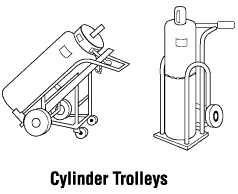
- Move cylinders with appropriate trolleys and secure the cylinders in an upright position.
- Use proper lifting cradles or a suitable platform when hoisting cylinders by a crane, derrick, or other hoisting mechanism.
- Secure cylinders in an upright position when cylinders are transported by motor vehicle. Close the value and use protective devices.
- Cylinders that need to be moved to different floors in a building must be transported in service elevators that are ventilated.
NOTE: Requirements for moving cylinders within the organization’s facility or property and those intended for transportation on public throughways are not the same.
DO NOT
- Do not lift a cylinder by the valve cap. Never sling with ropes or chains, or lift with electromagnets.
- Do not drag, slide, or drop cylinders. Do not roll on their sides. They can be rolled for short distances on their base.
- Do not allow the cylinders to strike each other with force.
- Do not place cylinders on their sides as rollers to move equipment.
- Do not lay acetylene cylinders on their sides. If an acetylene tank has unintentionally been left on its side, set it upright for at least one hour before it is used.
- Do not try to refill a cylinder or mix gases in a cylinder.
When should a cylinder be “cracked”?
Back to top
Cracking is a slight and slow opening of the cylinder valve. It must only be used for oxygen gas.
Before attaching a regulator to an oxygen gas cylinder, wipe clean the valve outlet with a clean cloth free of oil and lint and "crack" a secured cylinder by opening the valve slightly for an instant and then closing it immediately to blow out dust or dirt from the valve outlet before attaching a regulator. Use two hands on the valve and stand at the side of the valve - never stand directly in front of or behind the valve outlet.
Never “crack” flammable gas cylinders due to the chance of the gas igniting by friction, heating, or other ignition sources.
Never crack hydrogen cylinders since the release of compressed hydrogen may ignite by itself.
What should be done if fuel cylinders are on fire?
Back to topFollow the company's emergency response procedures.
If safe to do, the following steps can be done:
- Do not extinguish the fire unless the leak can be stopped immediately.
- Use a dry chemical or carbon dioxide fire extinguisher to put out small fires.
How do I transport cylinders on public roadways?
Back to top
Before any vehicle equipped with a welding gas system is operated on public roadways or parked on publicly accessible property, the employer must make sure the welding system (which includes the compressed gases) is transported in compliance with the Transportation of Dangerous Goods Act and regulations and the applicable highway traffic act.
Some of the requirements are:
- Whenever a mobile oxygen-fuel gas welding system is assembled as a cutting/welding or heating unit, an individual capable of competently operating the equipment must accompany the vehicle.
- The regulators and hose must be disconnected from the cylinders and placed in storage.
- On all cylinders, the valves shall be closed, and if the cylinders are designed to have protection caps, the protection caps must be in place.
- Transport cylinders in a suitably ventilated vehicle, ideally an open or flatbed truck.
- Make sure the cylinders are properly restrained and valves are protected during transport.
- Never transport gas cylinders in passenger vehicles.
- Fact sheet last revised: 2024-02-28